
On May 14, 2026, in collaboration with CTSI, the ETO's Anna and Inga facilitated The Encore, the closing plenary for TLS 2026: Signal to Noise. The session was held in Rotman's Desautels Hall with close to 150 attendees. For this type of interactive session to be successful, we needed to plan and set-up a digital discussion board in advance, share and promote The Encore throughout the symposium, gather and organize the key ideas shared in the discussion board which would then be used to facilitate group discussions. Oh, and we can't forget about the music to get people moving!

Jump to
- Planning and setting up the reflection activity
- Promoting and monitoring the discussion board
- Facilitating group discussions
Planning and setting up the reflection activity
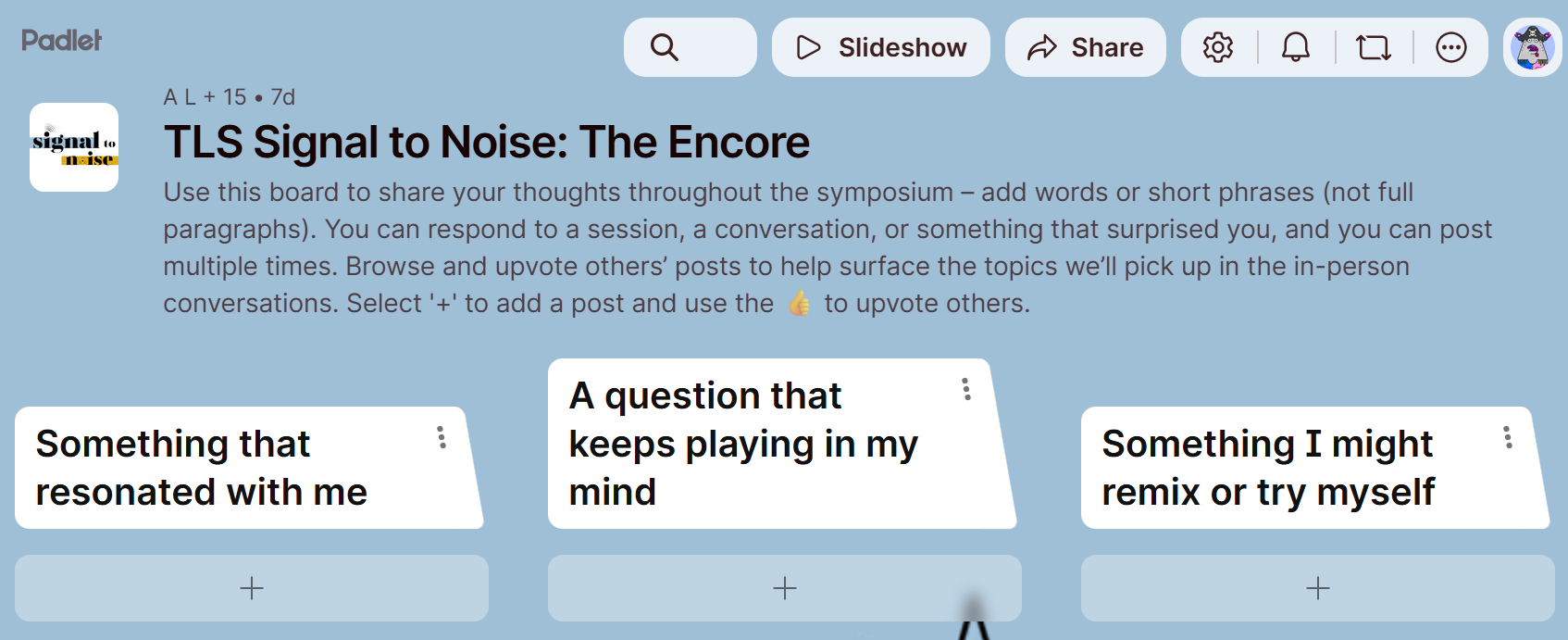
The idea for The Encore was inspired by a group discussion activity sometimes referred to as "Chat Now, Talk Later." The activity happens in two parts. First, participants respond to a prompt via an online platform (the "chat now" part). Then there is a group discussion that involves participants either elaborating on a word or phrase they submitted in the chat or selecting another word/phrase that resonated with them to discuss further (the "talk later" part).
With this year's symposium being fully in-person, we thought an activity such as this would be a great way for attendees to be able to share their reflections in a digital space, and kick-start the in-person conversations that would happen later on.
The discussion board was built in Padlet, an online collaborative platform that allows users to create and customize virtual boards where they can easily add and organize various content. The tool is commonly used for collaborative projects, brainstorming, and information sharing (check out the ETO's comparative guide on backchannelling tools).
We kept it simple with three prompts that were written to align with the Signal To Noise theme:
- Something that resonated with me
- A question that keeps playing in my mind, and
- Something that I might remix or try myself.
Once it was all set-up, we generated a QR code linking to the Padlet board.
Promoting and monitoring the discussion board

At every session during the symposium, attendees were encouraged to visit the discussion board (the QR code was displayed on the presentation slides) and share their reflections. By the end of Day 1, the board was filled with a number of new responses. People could also upvote an idea that was already submitted.
On Day 2, we pulled out the key themes that would be used to facilitate group discussions at The Encore. The five recurring themes identified were:
- Emotional labour and grieving in teaching practice
- Human-centered pedagogies and pedagogies of care
- Assessment, feedback, and meaningful evaluation of learning
- Inclusive and flexible teaching
- Active learning and classroom practices
Facilitating group discussions
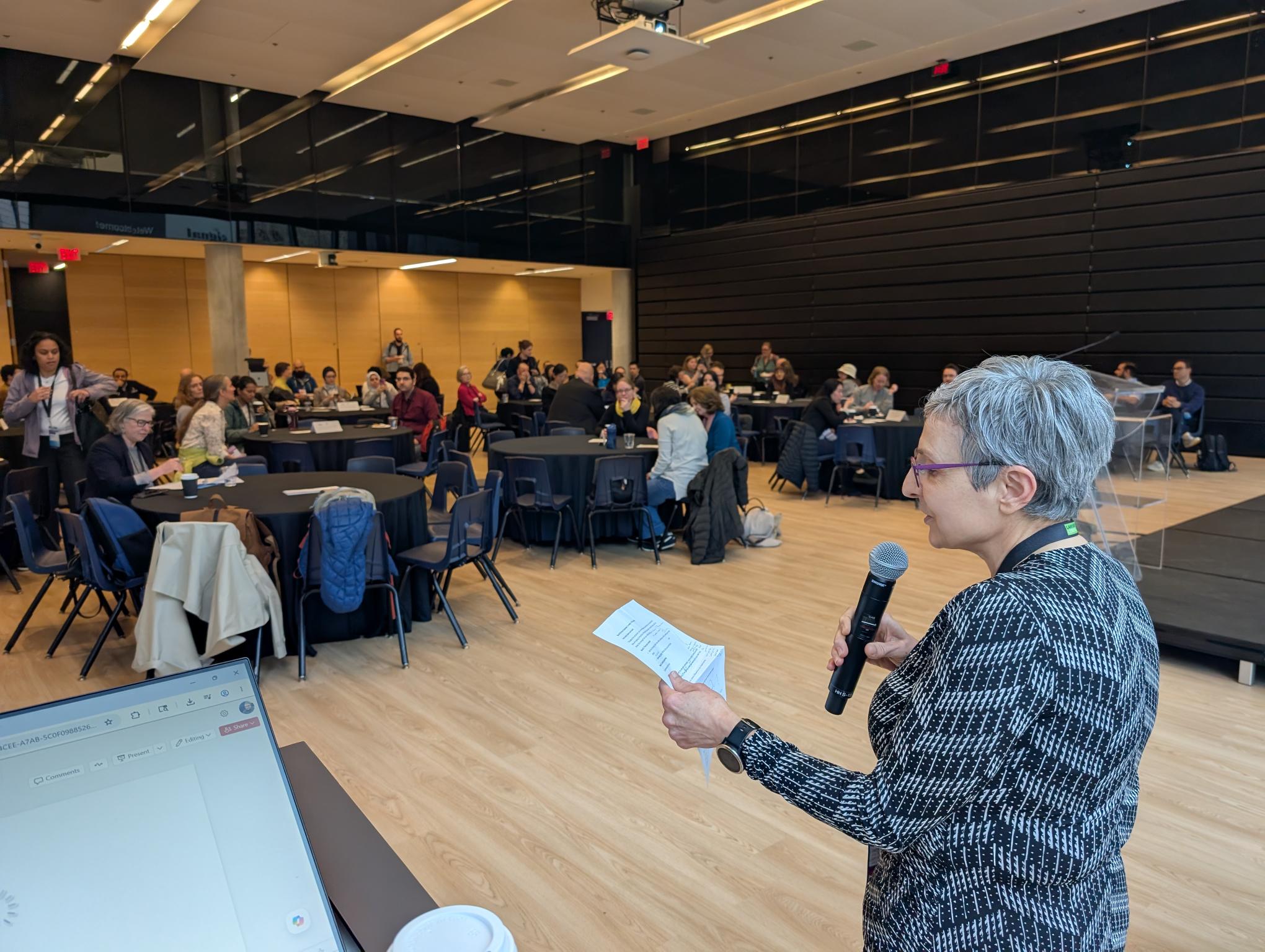
The space was set up with enough tables that each theme could appear on three tables. As participants entered the room, they were encouraged to sit at any table where they would have group discussion.
To encourage thoughtful and focused discussions, each theme came with a prompt and set of key words that were pulled directly from the discussion board.
- How are we navigating identity shifts in teaching, especially with AI and institutional change? (Key words: loss, change, adaptation)
- What does care look like in practice? How do we sustain it without burnout? (Key words: trust, safety, connection, relationships)
- How can we redesign assessment to be more meaningful and equitable while being growth-oriented? (Key words: fairness, usefulness, student agency, using student evaluations meaningfully)
- What small, practical changes can make courses more inclusive without major redesign? (Key words: UDL, neurodiversity, student voices, multimedia)
- What does active learning look like in our contexts? What gets in the way of achieving it? (Key words: talk less, low-tech alternatives, move from content-heavy courses to engagement and participation)
Participants had 10 minutes to engage in meaningful conversations with the people at their table. Then we cued the music to get people up and moving to another table (if this sounds a lot like musical chairs, it's because that's exactly what we were going for!). There were a total of three rounds that brought us right to the end, before the closing speech from Susan McCahan, Vice-Provost, Digital Strategies and Vice-Provost, Teaching and Learning.
Overall, we were pleased with the engagement and the opportunity to have meaningful conversations with colleagues about the concerns and interests of U of T faculty, students, and staff.